

Description
HappyHerbalist’s Kombucha Starter Culture — Torulaspora delbrueckii
We developed this Kombucha T. Delb strain over time ourselves to help keep that TTB <0.50% alcohol better attainable.
Explore the brewer’s art with our live Kombucha culture, grown with organic ingredients and selected for its distinctive Torulaspora delbrueckii yeast.
What You Receive
-
One large Kombucha culture (SCOBY), approximately 5 inches across and 1/4 inch thick
-
Liquid starter tea and tea for your first brew
Make one gallon to start. Each successive batch leads to more and more batches.
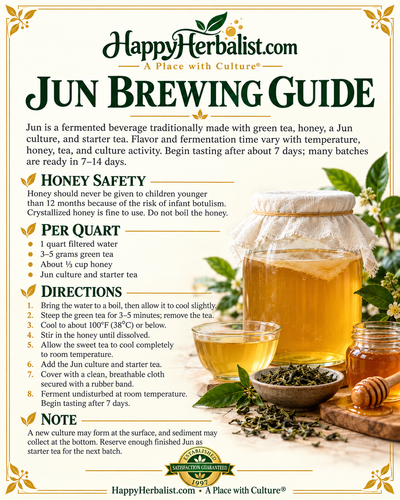
Download our free Kombucha Craft Brewing eBook for brewing instructions, culture care, and flavor ideas.
Great ideas how to control, calculate, raise and lower pH, acid levels, sugar levels, alcohol levels, and a simple method to lower - or increase alchol levels once your ferment has been harvested.
Why Choose Torulaspora delbrueckii?
Yeast selection helps shape fermentation speed, alcohol production, remaining sugar, and flavor. Our culture is selected for a slower fermentation profile, with lower alcohol as the brewing goal.
Your ingredients, temperature, oxygen supply, fermentation time, and storage all influence the finished drink.
Choose Your Sugar, Shape Your Brew
Consider which sugars you use. Torulaspora delbrueckii, does not ferment maltose or certain larger sugars, although they ferment glucose, fructose, and sucrose. Sugars left unfermented can contribute to a sweeter brew - but do not contribute to alcohol production. Stevia does not ferment but leaves a sweeter ferment calorie free.
Your choice of sugar—or a combination of sugars—helps develop your personal brewing goals and preferred balance of sweetness, flavor, and alcohol production.
Bacteria and Yeasts Working Together
Our culture combines T. delbrueckii yeast with Gluncobactor an acetic acid bacteria which consumes alcohol and produces beneficial acids, principle Acetic Acid and lesser acids.
The yeast produces alcohol and carbon dioxide as it ferments sugars. With oxygen available, the acetic acid bacteria convert alcohol into acids, contributing tartness and helping reduce alcohol as fermentation proceeds. The yeast produce equal amounts of alcohol and carbonation. The more carbonation the more alcohol. note that since Kombucha is traditionally fermented aerobically (exposed to the air, with only a cloth cover) much of the carbonation escapes. But is you bottle and cap and leave at room temperature when you open the bottle and theres a lot of carbonation that also means there's a lot more alcohol than the expected 0.5% close to 1 -even 2% alcohol.
Managing this balance is part of the brewer’s art.
Different Methods, Different Results - higher alcohol maybe you like a Kombucha Beer !
T. delbrueckii can also be combined with Saccharomyces yeasts to pursue a different fermentation profile, including a drier, higher-alcohol brew. Saccharomyces ferments fast producing high alcohol but quits sooner and stops producing alcoho. Where T. delbrueckii is a slower ferment abut lasts longer and continues to produce alcohol after Saccharomyces stops for the day. Both will stop at some point but all yeast ignite when shaken, stirred or exposed to more oxygen and or sugars.
Adding Lactobacillus bacteria produces lactic acid and offers another way to explore flavor. Depending on the species and strain, they can contribute lactic acid and alter the balance of the culture.Lactic acid will smooth out the Acetic acid profile. There are two major species of Lactobacillus one only produces lactic Acid (a smooth tasty and beneficial acid) or the other that produces lactic acid, carbonation (slightly)and alcohol (slightly). If you're using HOPS to flavor and enhance your Kombucha note that Hops will neuter your Lactobacillus bacteria, therefore it is normally added at the end stage and timing between hops and Lactobacillus bacteria is critical.
Start with our recommended method before experimenting with additional microorganisms. feel free to text, or email us we're happy to chat.
Bottling and Alcohol Content
Reduced oxygen can affect yeast growth and fermentation activity, but bottling does not reliably stop alcohol production. Test the finished brew and its behavior during storage if a specific alcohol level matters to you. Since you're starting with a lower alcohol producer (see charts) and with additional oxygen cut off when bottled the slower T Delb helps maintain the overall lower alcohol content.
30-Day Satisfaction Guarantee
Return any product within 30 days of purchase for a full purchase price refund. Products must be returned in good condition. Shipping charges are not refunded, and customers pay return shipping.
Need Help?
Text 919-518-3336 with a clear photo and your brewing questions.
Explore our Research Library.
Serendipity—it’s an adventure.
Free Shipping (USA) • Worldwide ($15)
HappyHerbalist.com est 1997
30 day Guarantee
Additional Details
- SKU:
- KS Deb