Best Milk for Making Kefir and Yogurt
All Milk Is Not Created Equal!
Updated October 2026 | HappyHerbalist.com
The quality of your milk makes a difference when growing live milk kefir grains and making homemade yogurt.
At Happy Herbalist, we have been helping customers successfully grow and maintain live milk kefir grains for many years. One of the most common questions we receive is:
“What is the best milk to use for making kefir?”
Our first recommendation is simple:
Choose fresh, whole milk that has been traditionally VAT pasteurized.
Whenever possible, choose certified organic milk from healthy, pasture-raised cows. We especially like milk that has been minimally processed and has not been homogenized.
Not all organic milk is processed the same way. Some organic milk is traditionally VAT pasteurized, while other organic milk is ultra-pasteurized (UHT).
Understanding the difference can help you select milk that produces consistent, delicious kefir and supports healthy kefir grain growth.
Our 30-Day Happy Herbalist Guarantee
We offer a 30-day satisfaction guarantee when our live milk kefir grains are used with fresh, whole, VAT-pasteurized milk, following our recommended fermentation instructions.
If you experience difficulties, please contact us. We will help troubleshoot your fermentation process and work with you toward a satisfactory resolution, including replacement or refund when appropriate under our guarantee.
Why do we recommend VAT-pasteurized whole milk?
Traditional VAT pasteurization heats milk to approximately 145°F (63°C) for 30 minutes.
This gentle, low-temperature process preserves much of milk's natural character while meeting established pasteurization standards.
We have found that fresh, traditionally pasteurized whole milk is a reliable choice for making kefir.
Other milk types can also work, but results may vary.
1. Best Milk for Kefir — Our Recommendations
| Milk type | Our recommendation | Comments |
|---|---|---|
| Organic, VAT-pasteurized whole milk | ⭐ Our first choice | Preferred for consistent fermentation and grain growth |
| Fresh, VAT-pasteurized whole milk | Excellent | Organic certification is desirable but not essential |
| Non-homogenized, cream-top milk | Excellent | Particularly good for rich, creamy kefir |
| Fresh pasteurized goat's milk | Excellent | Produces a naturally distinctive, often thinner kefir |
| Raw milk | Use caution | Requires careful sourcing and carries additional food-safety risks |
| HTST-pasteurized milk | Often works well | A practical alternative when VAT milk is unavailable |
| Powdered whole milk | Alternative | Results depend on processing and preparation |
| A2/A2 milk | Suitable | A2 protein does not inherently interfere with fermentation |
| Ultra-pasteurized / UHT milk | Not our preferred choice | May ferment successfully, but texture and grain growth can vary |
Important: UHT milk is not automatically unsuitable for kefir. However, Happy Herbalist prefers fresh VAT-pasteurized milk based on our experience with live kefir grains.
2. Recommended Organic VAT-Pasteurized Milk Brands
These dairies are good starting points when searching for milk suitable for homemade kefir.
Kalona SuperNatural — Iowa
One of our top recommendations
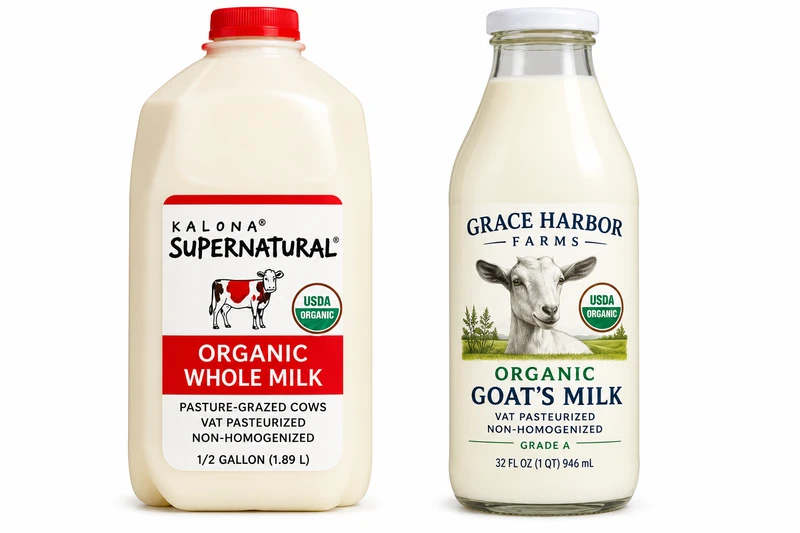
Kalona produces USDA Certified Organic whole milk using traditional low-temperature VAT pasteurization.
Its milk is also non-homogenized, allowing the cream to rise naturally to the top.
Why we like it: Organic, grass-fed, VAT pasteurized, and cream-top.
Working Cows Dairy — Alabama
Working Cows produces USDA Certified Organic, grass-fed milk using low-temperature VAT pasteurization.
Its non-homogenized whole milk is an excellent candidate for customers seeking traditionally processed milk.
Why we like it: Organic, grass-fed, VAT pasteurized, and non-homogenized.
Traders Point Creamery — Indiana
Traders Point produces organic, grass-fed, cream-top milk using traditional VAT pasteurization.
Why we like it: Organic milk from pasture-raised cows, traditional processing, and rich cream-top texture.
Alexandre Family Farm — California
Alexandre Family Farm offers organic A2/A2 milk, including selected VAT-pasteurized products.
Its organic 6% whole milk is a particularly rich option.
Important: Alexandre sells products using different pasteurization methods. Select only those specifically labeled VAT pasteurized if following our preferred milk recommendations.
A2/A2 milk is acceptable for making kefir. A2 refers to the type of beta-casein protein in the milk, not the pasteurization process.
3. Additional Local and Regional Milk Suppliers
Many smaller dairies offer excellent milk for kefir and yogurt. Some use traditional VAT pasteurization, while others use HTST processing.
We encourage customers to contact their local dairy and ask about its processing methods.
The following dairies are worth investigating. They are not all verified as currently offering certified-organic VAT-pasteurized milk.
| Dairy / Brand | What to look for |
|---|---|
| Jersey Girls | Fresh whole milk; confirm processing |
| Sky Valley Fresh Farms | Local dairy products; confirm availability |
| Steensma Dairy & Creamery | Fresh milk; confirm pasteurization |
| Stap Dairy | Whole milk; confirm processing |
| Hawthorne Valley Farm | Organic and biodynamic dairy products; confirm VAT processing |
| The Family Cow | Pasture-raised dairy products; confirm product and processing |
| Feliciana's Best Creamery | Fresh milk; confirm processing |
| Lifeline Farm | Organic dairy products; confirm VAT processing |
| Pete's Milk Delivery | Check locally available milk brands |
| Mountain Fresh Creamery | Fresh dairy products; confirm processing |
| Mill-King | Low-temperature milk products; confirm current organic certification and VAT method |
| Natural by Nature | Organic, grass-fed milk; not ultra-pasteurized according to the referenced shopping guide |
Natural by Nature deserves special mention. Its milk comes from organic farms in Pennsylvania, and the 2025 Gimme the Good Stuff guide identifies it as non-ultra-pasteurized. However, this does not establish that it is VAT pasteurized. Gimme the Good Stuff
How to Find Good Milk Near You
We recommend checking:
- Local organic dairy farms and Amish farms
- Natural food stores and food cooperatives
- Farmers markets
- Local cheese-making clubs
- Small independent dairies
- Farm stores offering traditionally pasteurized milk
Ask the dairy: “Is your whole milk traditionally VAT pasteurized at 145°F for 30 minutes, or do you use HTST or ultra-pasteurization?”
Your local cheese-making group may be particularly helpful. Cheese makers understand how different milk-processing methods affect fermentation and curd formation.
And remember: Milk kefir makes excellent homemade cheese!
4. What About Goat's Milk?
Prior w edid recommend and used Summerhil Goat Dairy ,but we did find later that it was not Vat Pasteurized. We have found that their powdered Goats Milk does ferment OK.
1. How powdered goat milk is manufactured
Most commercial powdered goat milk is produced using a process called spray drying.
The process generally involves:
- Pasteurization: The milk is heated to reduce harmful microorganisms.
- Concentration: Much of the water is removed, usually through evaporation under reduced pressure.
- Spray drying: Concentrated milk is sprayed into a chamber containing heated air. Water evaporates rapidly, leaving powdered milk.
- Packaging: The powder is protected against moisture and oxidation.
Although spray dryers use high inlet-air temperatures, the milk droplets generally remain considerably cooler because evaporation removes heat.
The important distinction: Spray drying is not the same as UHT pasteurization.
However, powdered milk may undergo significant heat treatment before drying. Some manufacturers use higher temperatures to modify milk proteins or improve powder characteristics.
Therefore, a manufacturer's statement that its powder is not UHT does not necessarily mean it is low-temperature processed.
2. An important finding about Summerhill's liquid goat milk
I checked Summerhill's current website. Interestingly, the company explicitly states that its liquid goat milk is HTST pasteurized at 161°F for 15 seconds, not UHT.
Summerhill also states that it previously used VAT pasteurization but switched to HTST around 2010.
Is Summerhill powdered goat milk good for kefir?
Your successful experience is meaningful evidence that the product can support kefir fermentation.
Milk powder retains lactose, proteins, minerals, and other nutrients needed by kefir microorganisms.
The more important question is whether the processing affects long-term kefir grain health and multiplication, rather than simply whether the milk ferments.
| Factor | What we know |
|---|---|
| Ability to produce kefir | You have successfully demonstrated this |
| Lactose availability | Generally retained in powdered milk |
| Protein quality | Depends partly on processing temperature |
| Grain multiplication | Not established for Summerhill powder |
| Long-term grain health | Requires testing |
| Suitability for customers | Promising alternative, with qualifications |
Dairy research confirms that milk powders can be manufactured using different heat treatments, and those treatments influence milk proteins and processing characteristics
VAT-Pasteurized Goat's Milk — U.S. Suppliers
Updated October 2026
Yes. I found five U.S. dairies with evidence of VAT-pasteurized whole goat's milk, including two additional suppliers not on our previous list.
These are suitable candidates for your Happy Herbalist blog, Best Milk for Kefir and Yogurt.
Recommended suppliers
| Dairy | State | VAT pasteurized | Non-homogenized | Where to buy |
|---|---|---|---|---|
| Grace Harbor Farms | Washington | Confirmed | Yes | Whole Foods |
| Risin' Creek Creamery | Indiana | Confirmed | Yes | Farm website |
| Cottage Hill Dairy | Oregon | Confirmed | Not verified | Farm website |
| Round Mountain Creamery | North Carolina | Historically confirmed | Not verified | Farm information |
| Cross Wind Farm | Ontario, Canada | Batch pasteurized | Yes | Farm website |
None of these has been verified as currently certified organic. Their principal qualification is the traditional VAT pasteurization method.
1. Grace Harbor Farms — Washington
One of the strongest recommendations for Happy Herbalist customers.
Grace Harbor Farms produces whole goat's milk from pasture-raised goats.
Its product description confirms:
- Small-batch VAT pasteurization
- Non-homogenized, cream-top milk
- No thickeners or stabilizers
- Available in 32-ounce bottles
Whole Foods lists the product, although availability varies by location. Whole Foods Market
2. Risin' Creek Creamery — Indiana
Risin' Creek specifically confirms that its goat milk is low-temperature VAT pasteurized and non-homogenized.
Its website lists half-gallon containers at $8, with purchases available through local farmers markets and pickup arrangements. The dairy does not ship its fresh milk. Risin' Creek Creamery
3. Cottage Hill Dairy — Oregon
New addition to your recommended supplier list.
Cottage Hill Dairy is a Grade A goat dairy near Oregon City.
Its farm listing explicitly confirms that it gently VAT pasteurizes whole goat milk.
It also produces goat milk kefir and yogurt, which makes it particularly relevant to your customers.
Products are available at Portland-area farmers markets, local stores, and the farm.
The listing was updated August 14, 2026. Local Harvest
4. Round Mountain Creamery — North Carolina
Another promising addition.
Located near Black Mountain, North Carolina, Round Mountain Creamery has produced Grade A VAT-pasteurized whole goat milk.
An Appalachian Sustainable Agriculture Project directory specifically describes its VAT-pasteurized goat milk and notes that it was suitable for making kefir, yogurt, and cheese.
However, that documentation is historical. I would contact the dairy to verify that it still produces and sells fresh VAT-pasteurized goat milk before recommending it to customers. ASAP Connections
Round Mountain Creamery information
5. Cross Wind Farm — Ontario, Canada
Cross Wind Farm confirms that its whole goat milk is batch pasteurized.
It offers 1-liter and 2-liter containers and processes milk shortly after milking.
This could be useful for Canadian Happy Herbalist customers. Crosswind Farm
Our preference remains fresh, whole, traditionally pasteurized goat's milk.
We also recommend looking for small local goat dairies that offer inspected, properly pasteurized milk.
5. Milk Processing: VAT vs. HTST vs. UHT
| Processing method | Typical temperature | Time | Happy Herbalist recommendation |
|---|---|---|---|
| VAT / LTLT | 145°F | 30 minutes | Our first choice |
| HTST | 161°F | 15 seconds | Often works well |
| Ultra-pasteurized | 280°F | At least 2 seconds | Not preferred |
| UHT | Approximately 280°F | A few seconds | Not preferred |
| Raw milk | Unheated | — | Additional safety risks |
Why We Prefer VAT Pasteurization
VAT pasteurization uses a lower temperature for a longer period.
It provides effective pathogen reduction while producing milk with characteristics we prefer for traditional fermentation.
Can You Use HTST Milk?
Yes.
Many customers successfully make kefir using ordinary HTST-pasteurized whole milk.
If VAT-pasteurized milk is unavailable, fresh HTST whole milk is a reasonable alternative.
Can You Use Ultra-Pasteurized Milk?
Sometimes.
Kefir grains can ferment ultra-pasteurized milk because lactose remains available for fermentation.
However, higher-temperature processing changes some milk proteins and may affect the finished kefir's texture.
For consistency, Happy Herbalist recommends avoiding UHT and ultra-pasteurized milk whenever practical.
6. Is A2 Milk Good for Kefir?
Yes. A2 milk can work very well.
A2 refers to a naturally occurring variation of beta-casein, one of the proteins in cow's milk.
It is not a pasteurization method, and A2 milk is not inherently inferior for kefir fermentation.
In fact, Alexandre Family Farm produces organic A2/A2 whole milk that is VAT pasteurized and non-homogenized. Alexandre Family Farm, LLC
We recommend choosing milk based primarily on freshness, pasteurization method, and suitability for fermentation rather than avoiding A2 milk.
7. What About Raw Milk?
Some experienced kefir makers prefer raw milk.
However, raw milk can contain harmful bacteria, including Salmonella, Campylobacter, Listeria, and pathogenic E. coli.
Even healthy-looking animals and farms with good sanitation practices can produce contaminated raw milk.
Regular inspections and testing reduce some risks but do not guarantee safety.
Fermenting raw milk into kefir does not reliably eliminate harmful pathogens.
For these reasons, Happy Herbalist recommends pasteurized milk as the safer choice, particularly for children, pregnant women, older adults, and people with weakened immune systems.
Customers considering raw milk should also check their state's laws.
8. Antibiotics, rBGH, and Other Milk Additives
We prefer milk from farms that emphasize animal welfare, responsible veterinary care, and transparent production practices.
Antibiotics
Milk containing illegal antibiotic residues cannot legally be sold for human consumption in the United States.
Milk from cows undergoing treatment with certain antibiotics must be withheld from the commercial milk supply for the required withdrawal period.
Certified organic dairy standards prohibit antibiotic treatment of animals whose milk will continue to be sold as organic.
rBGH / rBST
Recombinant bovine growth hormone, also called rBGH or rBST, is used to increase milk production in dairy cattle.
Its use is prohibited in USDA Certified Organic milk production.
Customers wishing to avoid milk from cows treated with rBST can select certified-organic milk or products labeled as coming from cows not treated with rBST.
Brands Historically Associated With rBGH Concerns
Older consumer lists have named brands such as Colombo, Kemps, Land O'Lakes, Lucerne, Parmalat, and Sorrento.
However, manufacturing practices and corporate ownership have changed.
We do not recommend publishing these brands as current rBGH users without recent, product-specific verification.
Instead, look for USDA Organic certification or a clear no-rBST statement on the product label.
9. Beware: Not All Organic Milk Is Equal
Organic certification does not tell you how milk was pasteurized.
For example:
Organic Valley: Offers products using different pasteurization methods. Check the specific carton.
Maple Hill: Its milk is identified as ultra-pasteurized in the referenced shopping guide.
Natural by Nature: Identified as organic, grass-fed, and not ultra-pasteurized.
Kalona SuperNatural: Explicitly identifies its organic whole milk as low-temperature VAT pasteurized.
Alexandre Family Farm: Offers selected organic VAT-pasteurized products, including its 6% whole milk.
The Gimme the Good Stuff milk shopping guide provides additional information about organic dairy, grass-fed milk, and processing methods. gimmethegoodstuff.org
Read the Healthy Cow Milk Shopping Guide
10. A Word About Ultra-Pasteurized Milk Manufacturers
Our original article included a long list of companies producing ultra-pasteurized milk products.
However, a dairy processor may manufacture several different products using different pasteurization methods.
A company producing ultra-pasteurized milk does not necessarily mean that every product it sells is ultra-pasteurized.
For that reason, we no longer recommend avoiding an entire dairy company based solely on its appearance in an industry directory.
Instead, check the processing method of the individual milk product.
Industry reference:
Dairy Foods — Ultra-Pasteurized Milk and Milk Products
11. Can You Make Kefir With Powdered Milk?
Yes.
Powdered milk can provide an alternative when fresh milk is unavailable.
For best results, choose plain whole-milk powder without added flavors or sweeteners.
Reconstitute according to the manufacturer's instructions using safe drinking water.
Allow the milk to reach the appropriate fermentation temperature before adding your live kefir grains.
Results may vary depending on how the milk powder was processed.
We generally recommend fresh whole milk for maintaining and multiplying kefir grains over extended periods.
Our Final Recommendation
At Happy Herbalist, our preferred milk for growing live milk kefir grains is:
Fresh, organic, whole, VAT-pasteurized milk.
Our leading recommendations include:
Kalona SuperNatural, Working Cows Dairy, Traders Point Creamery, and selected Alexandre Family Farm products.
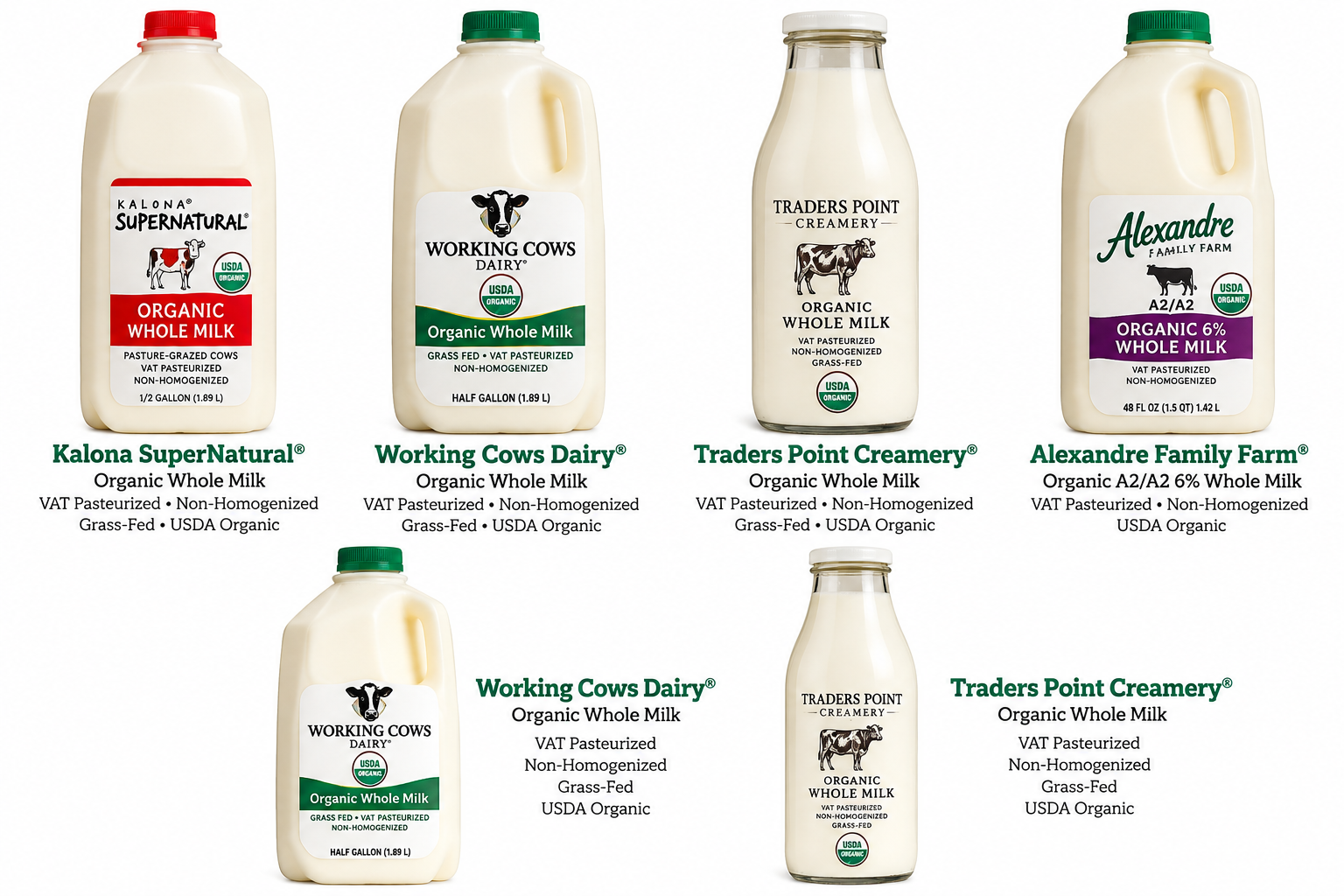
When those brands are unavailable, look for a local dairy offering traditionally VAT-pasteurized whole milk.
Remember, successful kefir fermentation also depends on the health and quantity of your grains, fermentation time, temperature, milk quality, and proper handling.
Our Favorite VAT-Pasteurized Goat's Milk
At Happy Herbalist, we recommend fresh, whole, traditionally VAT-pasteurized goat's milk for making homemade goat milk kefir.
Unlike UHT processing, traditional VAT pasteurization heats milk to approximately 145°F for 30 minutes.
Our recommended suppliers include Grace Harbor Farms, Risin' Creek Creamery, and Cottage Hill Dairy.
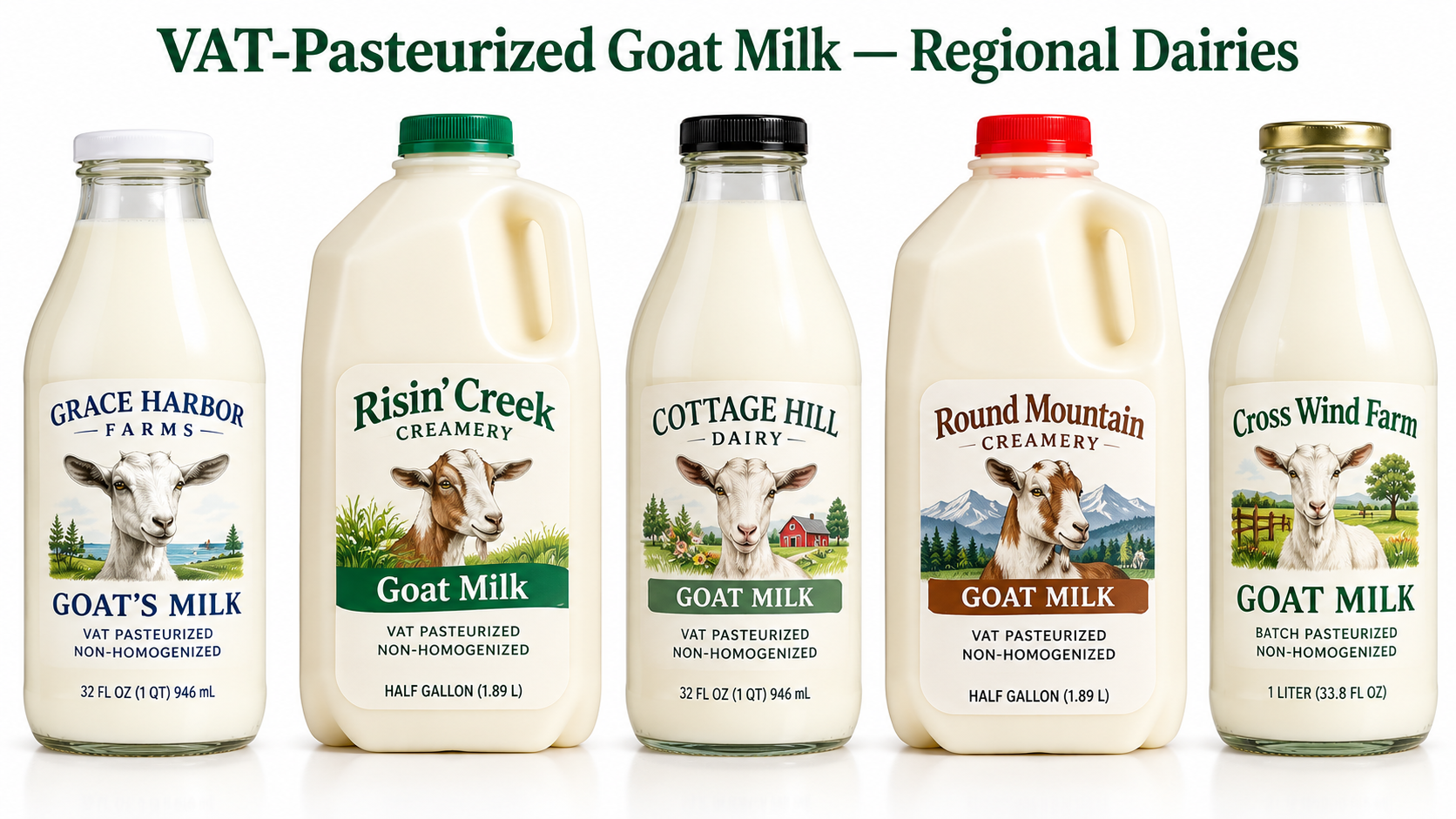
We are also investigating Round Mountain Creamery in North Carolina.
Availability varies by region, so we encourage customers to contact the dairy before purchasing
Final thought ... pasteurized milk leaves the cream on the top (unlike Homegenized which mixes thoroughly). Therefore you must shake and mix the pasteurized milk thoroughly before you use it. For those folks who want low fat then you can skim off the top and offer it to one that loves that cream (me)
Happy Fermenting!
Ed and Sue
small family online busiess since 1997
The Happy Herbalist.com
Helping People Make Traditional Fermented Foods Since 1997